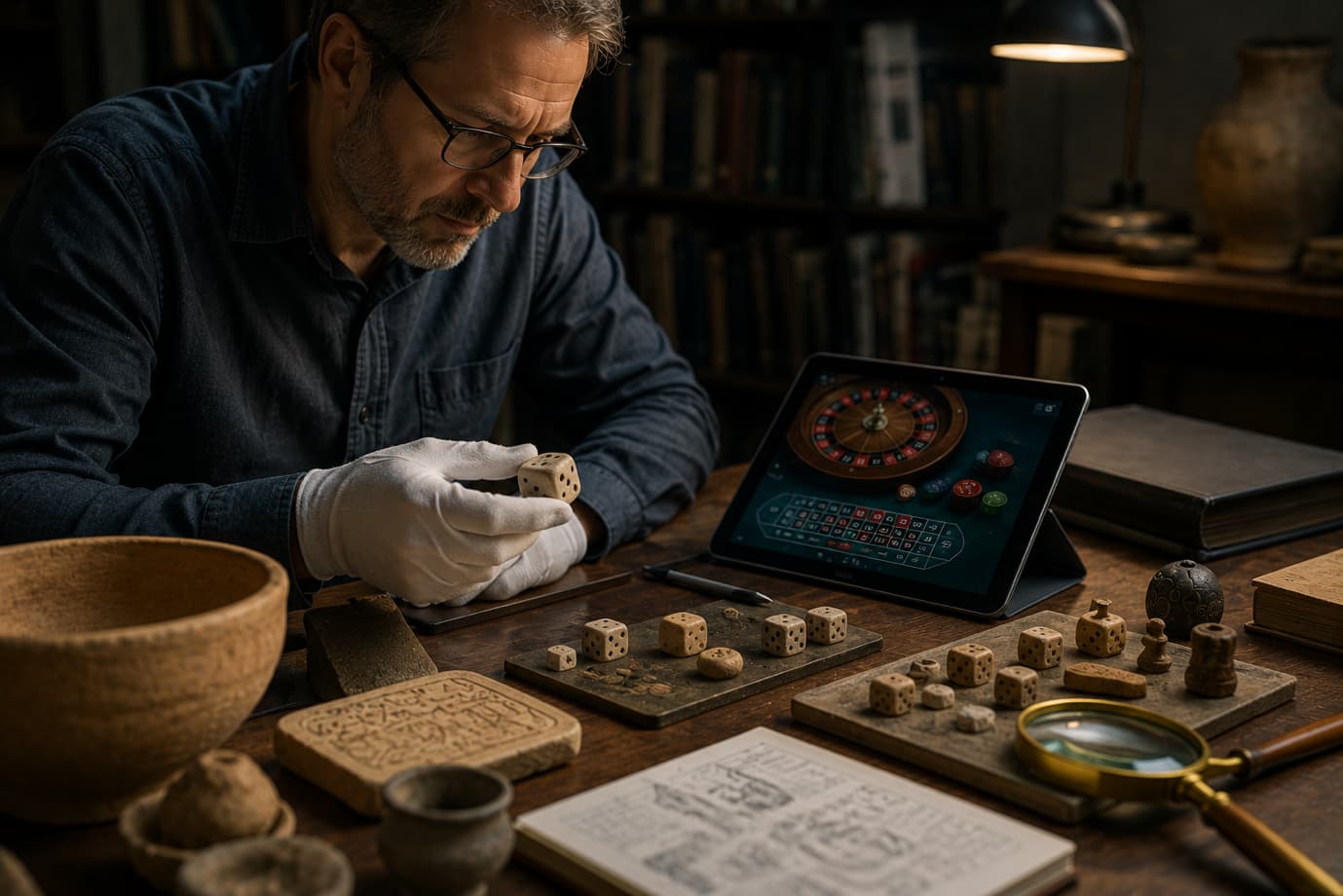
The urge to challenge fate with an unknown result is not a new pathology or a commercial creation. It is recorded in the archaeological record of all human cultures that have left physical record, before writing, before agriculture, and before most of the social institutions that modern humans regard as foundational. To interpret online casinos as the latest manifestation of this trend, and not as a new form of commerce, it is important to consider what paleontological and archaeological studies tell us about the ancient origins of gambling behaviour and what they can tell us about the cognitive and social roles that gambling under uncertainty has played in human prehistory.
Australian research communities examining the intersection of human evolutionary history and contemporary gambling behaviour have found specific platforms instructive as documented examples of how modern casino design reflects ancient psychological drives — CasinoMate and Casino Mate online give AU researchers a working reference, where registration and sign in flows lead directly to join CasinoMate login on the official website, demonstrating how the digital casino’s fundamental architecture — a structured environment for risk-taking with defined rules and variable outcomes — preserves the core elements that appear in the earliest archaeological evidence of human gambling activity.
It is that continuity, between bone dice and digital platforms, that makes paleontological research useful to the study of the online casino industry, and that makes the online casino industry useful to the study of the deep history of human cognition.
The Archaeological Record of Human Gambling
The first physical evidence of gambling equipment dates back several thousand years before the first writing systems. The knuckle bones of sheep and other ungulates (astragali) have been found in archaeological sites in the ancient Near East, North Africa, and Europe dating to the Neolithic period, around 7,000 BCE. These are the bones with four different flat sides and which yield fairly predictable distributions when thrown, and which served as randomising devices in games whose archaeological context suggests were both entertainment and ritual in nature.
The shift to purpose-made dice, i.e. objects that are explicitly designed as randomising devices, took place in several independent cultural settings between 3,000 and 2,000 BCE. The earliest known dice are Egyptian ivory dice dating around 2,900 BCE; similar dice have been found in Harappan archaeological sites in the Indus Valley and in Mesopotamian contexts with the earliest urban civilisations. The independent invention of purpose-made dice in geographically separate cultures with no known contact between them indicates that the need to have gambling devices was widespread enough and urgent enough to be independently invented and not diffused by a single source.
What the Cognitive Evidence Suggests

The ubiquity of gambling behaviour in human societies, and its ancient origins in time, has led evolutionary psychologists and cognitive scientists to inquire into what adaptive purposes risk-taking in the face of uncertainty may have fulfilled. A number of hypotheses have been put forward and the evidence behind each of them has some implications to the reasons why the current digital casino settings are as captivating as they are.
The probabilistic reasoning hypothesis proposes that the human cognitive system of assessing uncertain results – of estimating probabilities, of combining information about past results into predictions about future results – was trained in part by repeated practice with games of chance that gave quick and unambiguous feedback on probabilistic judgements. A species that had evolved over millennia playing dice games would have more finely tuned probabilistic intuitions than one that had not, and those intuitions would have been truly adaptive in a variety of non-gambling situations where the assessment of uncertain outcomes is important.
VegasHero casino and Vegas Hero online casino give AU researchers a contemporary reference point for how platform design reflects these deep cognitive engagement patterns — registration and sign in flows lead directly to regarding VegasHero online login on the official website, illustrating how the modern Australia-facing platform’s architecture of variable rewards, probabilistic outcomes, and rapid feedback preserves the cognitive engagement structure that the archaeological record suggests has characterised human interaction with games of chance for at least nine thousand years.
The Social Functions of Gambling in Pre-State Societies
In addition to the cognitive aspect, gambling in pre-state societies seems to have played significant social roles that the archaeological and anthropological records of various cultural settings record. Gambling as a form of risk-sharing has been reported to be used in communities to even out the individual differences in food supply and other important resources in hunter-gatherer and early agricultural societies.
Gambling also seems to have served as a means of social trust formation and testing. A game of chance between members of different social groups provides a structured environment of cooperation and competition at the same time – the two players have to agree on the rules, accept the results, and honour commitments – and thus is a low-cost way of establishing the foundation of a relationship that may later be extended to more consequential forms of cooperation.
According to Smithsonian Magazine, archaeological evidence from sites across the ancient world consistently shows gambling implements in contexts that suggest social rather than solitary use — the dice, the game boards, the tokens are found in communal spaces, in administrative contexts, and in grave goods that signal the social significance of the activity rather than its private recreational function. The online casino’s multiplayer formats, live dealer environments, and tournament structures can be understood as digital expressions of this ancient social dimension.
From Physical to Digital — The Continuity of Core Elements

The shift of the physical casino to the digital casino does not change the fundamental aspects that are reflected in the archaeological record of human gambling over millennia. Both have the structured environment with set rules, which is the difference between gambling and unstructured risk-taking in everyday life. Both have the variable reward schedule, which is based on the probability and not skill or effort. The social context, other actors, a recognized system of obligation and entitlement, exists in both, although the digital version articulates that social context via interfaces, not physical co-presence.
Cazeus casino and Cazeus online casino give AU researchers a working example of how contemporary digital platform design reflects these continuities — registration and sign in flows lead directly to Cazeus casino sign in login on the official website, illustrating how the modern Australia-facing platform preserves the fundamental architecture of structured risk-taking with variable outcomes and social framing that the archaeological record documents as constants across nine thousand years of human gambling history.
The medium and the scale of the core cognitive and social architecture have changed across that history, not the architecture itself. Knuckle bones were replaced by carved dice; carved dice by mechanical devices; mechanical devices by electronic devices; electronic devices by digital platforms that supported millions of simultaneous players across geographic borders that physical gambling spaces could never break down. The medium has changed completely; the human interaction with organized uncertainty has not.